SAFETY AWARENESS | Introducing the Data Center Safety Awareness Certificate
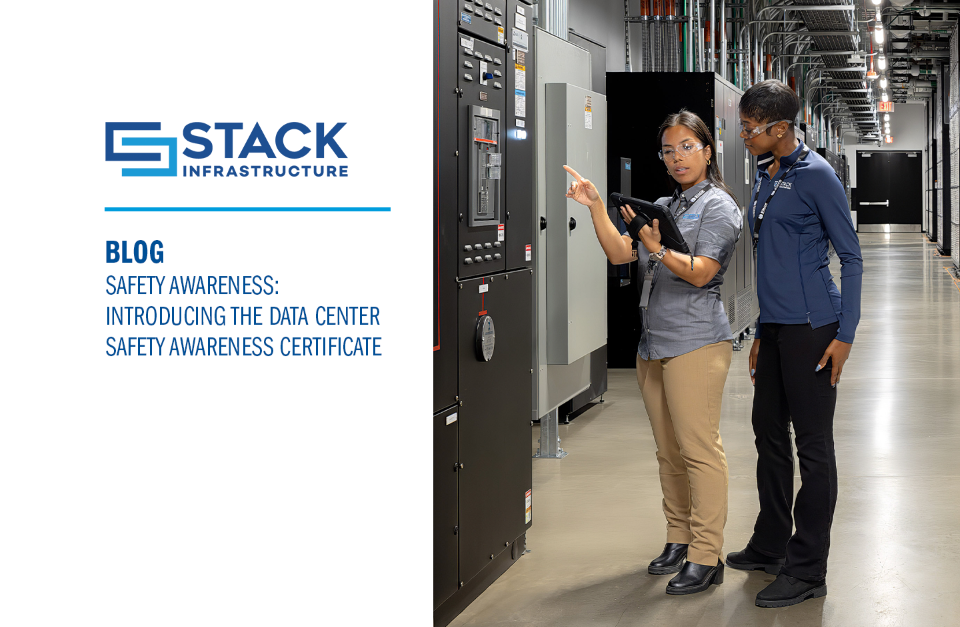
In November 2025, the Data Center Safety Council (DCSC) launched the industry’s first Data Center Safety Awareness Certificate, an online credential designed to establish a common baseline of safety awareness practices for an operational data center. The program is built around the sector’s unique operating conditions, from electrical and chemical risks to heat, noise, and emergency response, and reflects years of Environmental, Health, and Safety (EHS) lessons learned across industry operators and global regions.
Why Data Center Safety is Different and Why Generic Training Falls Short
The data center industry continues to scale at an unprecedented pace, with expanding capacity, higher densities, and more complex operating environments coming online each year. Data centers function as mission critical, multi-employer, 24×7 industrial facilities that operate under live electrical conditions and evolving technical demands. High density and novel cooling approaches are managed inside secure environments that must remain fully operational while work proceeds, leaving little margin for error as more people and more systems converge on the same floors. Together, the following factors reinforce why standardized, industry-specific safety practices are critical to sustaining performance in increasingly complex data center environments.
- Why a Common Safety Language Matters. Within a typical facility, employees, contractors, vendors, and original equipment manufacturer (OEM) field technicians work side by side, often under shared responsibility as defined by OSHA’s multi-employer worksite framework. In this context, a common baseline of safety awareness and a shared operating language are not simply best practices. They are foundational to reducing risk at the intersection of multiple employers and underscore the need for consistent safety expectations across employers and sites.
- Limitations of Generalized Safety Frameworks. Most widely used safety training programs were not developed for the realities of operational data centers. Early discussions within the DCSC revealed wide variation in baseline requirements, ranging from OSHA 10 General Industry to OSHA 10 Construction, with neither approach adequately addressing many day-to-day risks unique to operational data centers. While electrical standards such as OSHA 29 CFR 1910 Subpart S and NFPA 70E remain critical, they do not capture the operational realities of energized meet me rooms, generator yard work during severe weather, or hot aisle interventions on high density AI racks. Compliance with general frameworks must be paired with competencies tailored to how data centers actually operate.
- Safety as an Uptime Control. The cost of inconsistency is rising. Uptime Institute data shows that power issues remain the leading cause of impactful outages, accounting for 45% of incidents. One in five significant outages costs more than one million dollars, and most are considered preventable with better management, process, or configuration. Uptime risk is also becoming more external and interdependent, driven by growing threats to the power chain from aging grid infrastructure and the destabilizing effects of intermittent renewable energy sources, alongside weather events, third party software, and network dependencies. In this environment, a standardized safety baseline helps reduce the likelihood and impact of human factor contributors across a fragile and complex operating ecosystem.1
A Growing Workforce Requires a Stronger Foundation
The rapid expansion of the data center industry presents an opportunity to develop the next generation of skilled professionals. Uptime Institute’s latest survey suggests that demand for experienced operations leaders and skilled electrical and mechanical trades continues to rise, and many operators are actively investing in hiring and retention, recognizing that workforce development is now central to operational success. As capacity expands, staffing needs are projected to exceed three million full time equivalents by the end of the decade, up from 2.3 million at the end of 20252. This growth underscores both the scale of opportunity and the importance of preparing new entrants to succeed in complex, high-performance environments. While risk profiles are remarkably similar across facilities, the way risks are managed can vary widely. A standardized, transferable foundation in data center safety is one of the fastest ways to onboard new talent safely and consistently.
Closing The Gap: A Fit for Purpose, Global Baseline
The Data Center Safety Awareness Certificate is a pragmatic response to the realities of a rapidly scaling industry. Developed by the DCSC and its membership, the program scope and content were defined by subject matter experts across the sector, with the Certus platform selected to deliver the course for its ability to keep content current and support ongoing maintenance. The program development involved extensive collaboration with major operators, lease providers, and hyperscalers, with input from North America, Europe, Australia, and beyond to ensure a globally applicable approach rather than a U.S.-centric one, drawing inspiration from industries such as oil and gas and mining that have long relied on standardized safety baselines.
The course includes 16 self-paced modules covering site access, pre- job planning, electrical hazards, control of hazardous energy, confined spaces, fire prevention, heat and noise hazards, chemical management, water systems, working at heights, and housekeeping expectations. It also addresses security protocols, uptime sensitivity, and privacy considerations unique to data centers. The course culminates in a validated exam supporting a two-year credential that is mobile friendly and designed for both individual learners and enterprise deployment through learning management systems.
The certificate is not a replacement for advanced qualifications, site-specific authorizations, or jurisdictional requirements. Rather, it is a base-level awareness. It’s a shared, verified vocabulary of risks and controls that every worker on-site should demonstrate whether they’re a seasoned controls technician, an OEM field engineer, or a first-time contractor.
1 Uptime Institute 2025 Global Data Center Survey
2 Uptime Institute 2024 Global Data Center Survey
From Announcement to Adoption
Early feedback from operators, contractors, and safety leaders has been clear. The Data Center Safety Awareness Certificate program content resonates across experience levels, and the flexibility of a self-paced, globally applicable format is widely viewed as essential. Many organizations are already treating the certificate as an expected baseline for working in operational environments.
Turning that baseline into measurable value requires intentional adoption. Here’s how operators, suppliers, and contractors can translate a shared credential into real safety and reliability outcomes.
- Adopt the baseline as a gate requirement. Make completion of the Data Center Safety Awareness Certificate a prerequisite for site access for employees, contractors, vendors, and others performing work. Align renewals with the two-year credential and integrate verification into existing Learning Management Systems (LMS) and vendor management systems. Setting clear expectations at the gate ensures safety conversations begin from a shared baseline.
- Standardize the handoff. Use the certificate to streamline on-site inductions and focus local training on site-specific procedures, permits, and hazards. By eliminating repetition of general safety concepts, teams can reduce onboarding time while improving the quality of pre-job planning and work authorization.
- Measure what matters. Track key safety and operational indicators such as time to work authorization, induction duration, near miss reporting, and first year incident rates. Compare results for workers with and without the credential and link trends to outage and quality data. With a growing share of major incidents both costly and preventable, standardized training delivers measurable return.
- Keep iterating together. As rack densities increase, cooling technologies evolve, and workflows change, baseline training must evolve with them. Feed lessons back to the DCSC so modules and scenarios can be continually updated to reflect current operating realities. This sector wide feedback loop is what keeps a baseline relevant, credible, and useful over time.
A Note On Scope
The Data Center Safety Awareness Certificate is not designed to replace electrical qualifications, licenses, or any jurisdictional standards. It complements them, much as ASHRAE guidance complements OEM specifications or ISO 30134 metrics complement utility billing data. The goal is consistency and transferability across roles, companies, and geographies, giving the industry a shared starting point for safe work in complex, mission critical environments.
The Broader Mandate
Safety, sustainability, reliability, and energy planning are converging disciplines. The same growth forces driving AI capacity are reshaping grid planning, permitting, thermal design, and workforce models. We will not meet the demands of this next phase of industry growth if we continue to operate in silos.
The Data Center Safety Awareness Certificate is a practical, immediate step toward alignment. It gives the industry a common starting point so we can spend less time reteaching the basics and more time doing the work that keeps people safe and services available.
STACK is proud of the cross-industry collaboration behind this certificate and what it signals for the future of our sector. By bringing together operators, suppliers, and safety leaders to define a shared baseline, we have created a program that is practical, scalable, and designed for how data centers actually operate. That kind of collaboration is how this industry raises standards and moves forward together.
Call to action: Operators, contractors, and suppliers should adopt the baseline. Investors and customers should expect it. And the workforce, present and future, should take the course, bring questions, elevate new ideas and enhancements, and help keep raising the bar on safety. That is how this industry scales with confidence.
Access more information or get started here:
DCSC
Certus Registration
By Donna Lynch, Senior VP, Environment, Health & Safety, STACK Infrastructure; Immediate Past Chair of the Data Center Safety Council
March 23, 2026