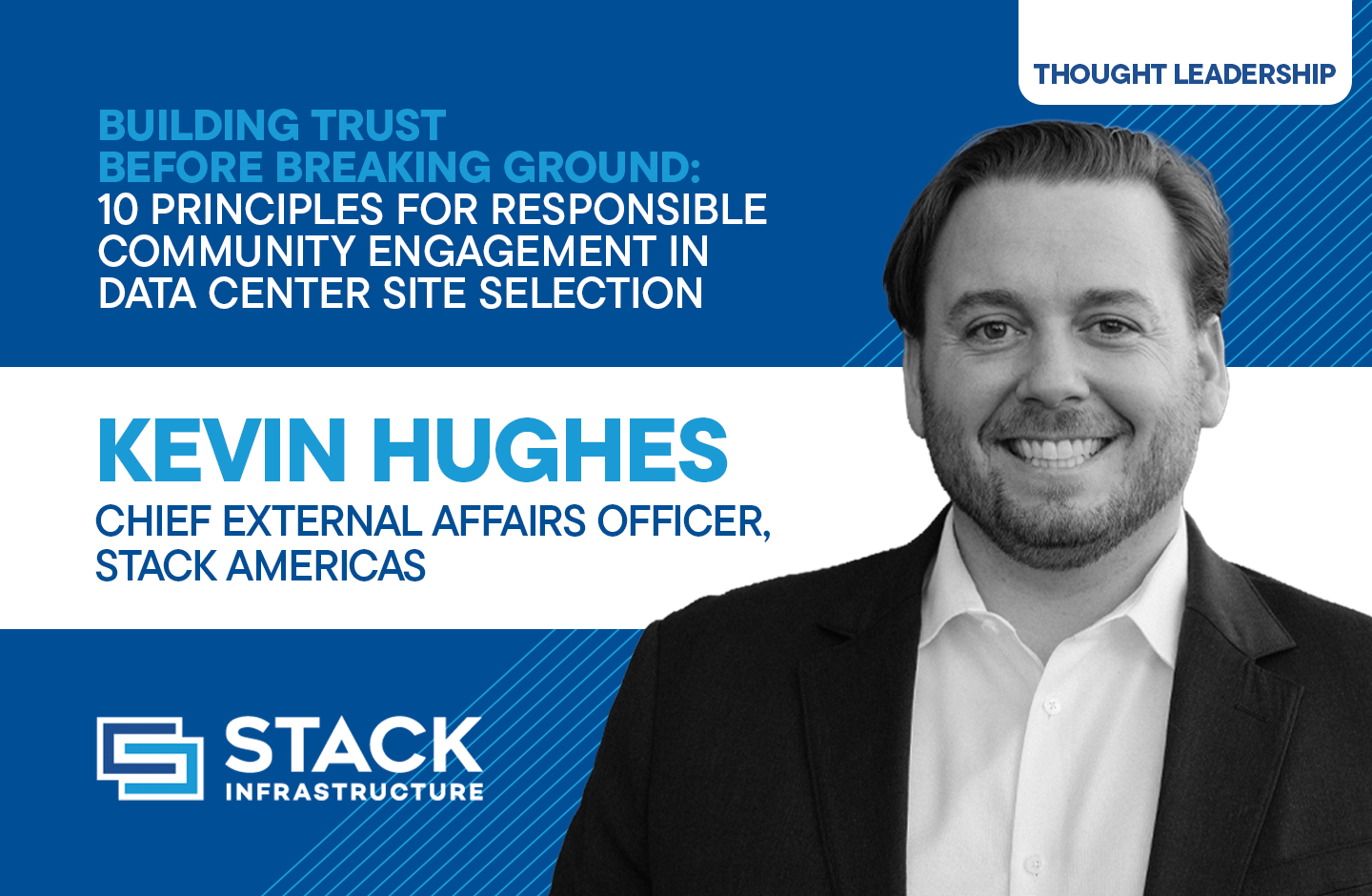
Building Trust Before Breaking Ground: 10 Principles for Responsible Community Engagement in Data Center Site Selection
Community Trust Is Foundational to Responsible Development
Before permits are filed or communications are developed, every digital infrastructure developer should answer a fundamental question: Does the host community have reason to trust this project?
In many cases, the answer is: not yet.
That is not an indictment of the industry. It is simply the reality of the moment. According to the 2025 Edelman Trust Barometer, which surveyed more than 33,000 people across 28 countries, the United States ranks among the world’s least trusting nations, with a Trust Index score of 47 out of 100. Six in ten respondents reported a moderate to high sense of grievance, rooted in a belief government and business work for narrow interests rather than the public good.
Gallup’s parallel research confirms only three institutions earn majority confidence from Americans: small business, the military, and science. Big business registers at 21%. Congress sits at around 10%. Large technology companies, the very sector driving demand for the data centers this industry builds, have seen their trust scores fall sharply across both political parties.
Now layer in public perceptions about data centers. When asked in a Gallup poll, “Overall, would you strongly favor, somewhat favor, somewhat oppose or strongly oppose the construction of a data center in your area to support artificial intelligence, or AI technology in the U.S.?” seven in 10 Americans surveyed opposed local construction.
This is the operating environment for new development. Ignoring it introduces avoidable risks.
Responsible development starts with acknowledging this reality and making a deliberate choice to address it. And critically, “building trust” means more than getting a community to trust your company. It means making certain elected officials and their staff have sufficient information to exercise genuine oversight. It means creating real pathways for community voices to be heard and to matter. It means earning the right to operate and legal permission to do so.
Communities increasingly expect transparency, accountability, and meaningful participation in decisions that will affect them for decades. Meeting those expectations is not simply good citizenship. It is prudent risk management.
Many digital infrastructure projects are straightforward in one respect: the owner-operator identifies a site, enters the market, and begins engagement from a clean slate.
This is not always the case. And when prior activity exists, the stakes for community engagement increase materially.
In today’s hyperscale-driven development environment, it is increasingly common for land developers to acquire and prepare sites speculatively, ahead of any identified end-user. These developers may grade land, pursue entitlements, or make public moves that generate community attention before the company that will construct, own, and operate the facility has any involvement.
By the time an owner-operator enters the picture, a narrative may already exist. Sometimes, community perceptions are shaped before the future operator has spoken a single word publicly. Community members may have attended contentious zoning meetings. Neighbors may have organized opposition. Local officials may have made public commitments one way or the other.
In these cases, community engagement functions as a reset rather than an introduction. A reset requires more intentionality, more humility, and more patience than a clean introduction ever would.
Whether you are starting fresh or walking into someone else’s aftermath, the following principles apply, but when it’s the latter, every step carries extra weight.
Principles for Responsible Community Engagement
1: Identify Sentiment Before You Commit
When an owner-operator begins investigating a site’s viability, the instinct is to move quietly. There are legitimate reasons for this: signaling interest in a specific market or geography can invite competition, inflate land prices, and complicate commercial negotiations. Confidentiality in early site selection is often treated as protective.
That approach carries risks that are rarely reflected in financial models. Community sentiment should be evaluated with the same rigor as power availability, fiber connectivity, land suitability, and entitlement risk.
Before making any meaningful commercial commitment to a site, before a letter of intent, before exclusivity, before significant internal capital is deployed, it is worth investing in a candid assessment of community sentiment. This does not require public disclosure. It can be done through trusted local intermediaries, through existing economic development relationships, through a review of public records and local press. The goal is simple: know what you are walking into.
If the sentiment is neutral or positive, you have a foundation to build on. If it is negative, you have a decision to make, and it is far better to make that decision before signing a contract than after.
2: Use Exclusivity to Create Space for Transparency
One of the structural tensions in responsible community engagement is the conflict between competitive confidentiality and community openness. Companies feel they cannot be transparent about their interest in a location because doing so exposes them to competitive risk.
The solution is contractual, not cultural.
When entering into an agreement with a landowner for a prospective site, negotiate for a meaningful exclusivity and diligence window. A well-structured exclusivity arrangement substantially reduces the competitive exposure that drives secrecy. Once under contract, the constraints on early engagement are significantly reduced. This shift allows community engagement to run in parallel with technical diligence, which reduces downstream permitting and reputational risk. Community engagement can and should begin in parallel with site diligence, not sequentially. Waiting until all the technical and commercial boxes are checked before talking to the community sends an implicit message: we make our decisions first and explain them to you afterward. That is precisely the dynamic that erodes trust.
Exclusivity creates an opportunity to move from secrecy to engagement without materially increasing competitive risk.
3: Make the Decision to Be Transparent
Transparency is not a tactic you deploy when it is convenient. It is a decision you make at the outset and is a commitment that governs everything that follows. The first test of that commitment is simple: are you willing to say, clearly and early, who you are and what you are considering?
You cannot plan to build trust by starting the conversation in secrecy. Communities are not naive. They notice when information is withheld. They fill the vacuum with speculation. And speculation, in a low-trust environment, often trends negative.
The first act of community engagement is a decision made internally, at the leadership level, that this project will be conducted transparently and the company will identify itself. That it will communicate honestly about what it knows and what it does not yet know. That it will not hide behind third-party representatives or corporate euphemisms.
This decision costs nothing. It shapes everything.
4: Use NDAs Selectively and Transparently
Non-disclosure agreements (NDAs) are often portrayed as the enemy of transparency. In community engagement contexts, they can invite suspicion: What are they hiding? But this framing can miss what NDAs, used well, can accomplish.
A thoughtfully scoped NDA allows a company to share more information, not less. It creates conditions for candid conversations with public officials and technical staff about early-stage plans, preliminary engineering, sensitive financial structures, and other details that cannot be disclosed broadly without consequence. Without that mechanism, the alternative is often not more openness; it is carefully managed vagueness.
The key is intentionality and restraint. NDAs should be limited to specific parties, specific purposes, and specific timeframes. They should cover what genuinely requires protection, not serve as a blanket shield for everything the company would prefer not to discuss.
And critically, in most circumstances, elected officials should not be asked to sign NDAs. The public’s representatives have both the right and the responsibility to engage openly with their constituents. Placing them under confidentiality constraints undermines that function. There may be rare situations, such as active permitting negotiations and sensitive infrastructure disclosures, where limited, purpose-specific confidentiality with elected officials is warranted. But these should be narrow exceptions, clearly explained, and not standard practice.
When you use NDAs, say so. Explain what they cover and why. Describe the limits you have placed on them. When applied selectively and explained clearly, NDAs support more productive early-stage discussions.
5: Do Your Homework on the Community
Digital infrastructure projects are not interchangeable, and neither are communities.
Before your first external conversation, invest seriously in understanding the community where you are proposing to build. Its history. Its economic trajectory. Its institutions and their relationships to one another. Its leaders, both formal and informal. Its past experiences with large development projects. Its concerns about growth, the environment, infrastructure, and taxation.
For data center developers, this includes understanding local perspectives on power usage, water resources, land use, and long-term infrastructure impact.
Economic development organizations and business associations are natural starting points, and they can be genuinely valuable. But they represent a particular constituency: those with an existing interest in attracting economic activity. Their perspective is important. It is not complete.
Responsible diligence in a community means going beyond the obvious stakeholders. It means seeking environmental advocates, faith communities, neighborhood associations, educators, and residents who have no institutional stake in the outcome. These conversations will surface concerns and priorities that won’t appear in an economic development pitch deck, and they are far better to hear before a proposal is filed than after a permit is challenged. Communities are ecosystems of relationships, history, and local priorities. Understanding those dynamics is as important as understanding utility infrastructure.
6: Build Relationships Before You Build Anything Else
After the homework comes the human work.
Develop a high-touch, in-person engagement strategy that reaches a genuinely broad range of community leaders and stakeholders. This means elected officials at every level, not just the most powerful. It means business leaders and chambers of commerce, but also environmental organizations, school systems, non-profits, faith institutions, and the kinds of quietly influential community voices that don’t hold formal titles.
These conversations should be substantive, not performative. Show up prepared. Listen more than you speak. Ask real questions and give real answers. And when you don’t have an answer yet, say so, honestly, without evasion.
In fact, one of the most powerful things you can do in early community conversations is to acknowledge the limits of your own certainty. Projects at this stage involve genuine unknowns: infrastructure configurations, employment projections, construction timelines, water and energy requirements. Presenting artificial precision on these questions doesn’t build confidence; it creates vulnerability when the numbers change. Saying “here’s what we know, here’s what we’re still working through, and here’s how we’ll keep you informed” does more for trust than any polished presentation.
Trust is built through repeated interactions, not presentations.
7: Make the First Conversation the Beginning of Many
A single round of stakeholder meetings is not community engagement. It is announcement preparation. Establishing a predictable communication cadence reduces speculation and improves stakeholder alignment over time.
At the end of every early conversation, be explicit about two things: where you are in the process and how you will stay in contact. Set expectations for the cadence and format of future communications. Follow through on them, even when there is nothing new to report, because “nothing new to report” is useful information that prevents speculation from filling the void.
The goal is continuity. Relationships built over multiple touchpoints, through different phases of a project, are qualitatively different from relationships initiated through a single meeting. They accumulate credibility. They create accountability on both sides. And they transform stakeholders from passive recipients of information into active participants in the project’s evolution.
8: Think Carefully About Incentives
At some point, the question of public incentives will arise. Tax abatements, infrastructure contributions, enterprise zone designations, and utility rate structures are all forms of public investment commonly associated with digital infrastructure projects. There is nothing inherently wrong with that. These investments, well-structured, can generate returns for communities that far exceed their cost.
But the how and when of the incentive conversation matter enormously for trust.
The adage worth holding onto here is: take what you need, not what you can get. Maximizing incentive capture may improve near-term project economics while undermining long-term community relationships. Public officials and their constituents notice when a company with a multi-billion-dollar project seeks relief it does not appear to need. That perception is corrosive. Sustainable incentive structures align project viability with measurable community benefits.
Timing is equally important. There is a reason this step comes after relationship-building rather than before it. Knowing what you genuinely need requires understanding the project and the community. Making the ask from a position of established trust, with demonstrated commitment to the community’s interests, produces better outcomes than arriving with an incentive proposal before anyone knows your name.
Don’t show up to the introduction with an ask.
The most durable incentive structures are those clearly linked to measurable public benefits and long-term community outcomes.
9: Go Public Early and Provide Accessible, Factual Information
There will always be opponents to large development projects. That is a constant. Some concerns are legitimate and deserve to be taken seriously. Some opposition is reflexively anti-development and will not be moved by any amount of engagement. Accepting this reality is part of operating responsibly.
What is not constant, and what responsible engagement can genuinely influence, is how the large middle ground of the community forms its opinion.
Well before a final decision is made, broaden the scope of public information sharing. Host public meetings. Publish factual information about the project. Get ahead of rumors before they circulate. This is not a communication exercise. It is a requirement for informed community participation. It is an act of respect for the community’s right to engage with real information rather than speculation.
The undecided will form their views from somewhere. If the information landscape is dominated by opposition narratives and community anxiety, that is where they will land. If there is a substantive, factual, accessible account of what is being proposed and what protections are in place, the conversation changes.
This step requires confidence. It means engaging publicly before you are certain of the outcome. That vulnerability is precisely what makes it credible. In today’s environment, misinformation travels faster than project facts. Developers who delay communication often allow others to define the project before they do.
10: Show What Changed
This may be the most underutilized tool in responsible development.
Community engagement that genuinely influences project design is rare enough that when it happens, it should be documented and communicated explicitly. Did residents raise concerns about sound attenuation? Did that produce a larger setback or upgraded acoustic barriers? Did community feedback surface a need for offsite road improvements? Did a conversation with an environmental group change the stormwater design? Did a meeting with historic preservation advocates redirect a facility’s orientation?
When community input influences project design, document and communicate those changes. Name the stakeholder or community voice. Describe what was raised and how it shaped the project.
This communication is not a PR strategy, though it will serve that function. It is evidence engagement was a genuine two-way exchange rather than a consultation exercise that reached predetermined conclusions regardless of what was heard.
Demonstrated responsiveness increases community support and reduces long-term opposition risk. Communities that feel heard but ignored become, understandably, cynical. The difference between these outcomes often comes down to one thing: whether the company was willing to change something.
And when a final decision is made to proceed, resist the impulse to reduce the announcement to a press release. You have spent months, perhaps longer, bringing stakeholders along. You have built meaningful relationships and earned the ability to celebrate with the community, not simply deliver an announcement.
Most importantly: recognize engagement doesn’t stop with a shovel in the ground. These projects will be in the community for decades. The power they consume, the workers they employ, the roads they wear, and the tax base they contribute to, all of this will be woven into the fabric of community life long after the construction crews have left. The engagement that preceded construction should be understood as the foundation for a permanent relationship, not a hurdle cleared on the way to operations.
If you can, hire someone from the community to carry this work forward through construction and into operations. The shovel in the ground is not the end of community engagement. It is the beginning of the obligation. Communities rarely expect perfection. They do expect responsiveness.
Closing Thoughts
Responsible community engagement is often described as the right thing to do. It is. It is also an effective business strategy. Companies that approach it seriously tend to move through public processes more efficiently, face less opposition, and build stronger, lasting relationships with communities.
As digital infrastructure development accelerates across North America, the industry’s success will increasingly depend not only on where we build, but on how we build, our responsible development principles, and the trust communities and our clients place in us. Companies that view community as a critical input will be better positioned to secure approvals, maintain credibility, and build long-term relationships that every project needs to succeed.
By Kevin Hughes, Chief External Affairs Officer, STACK Americas
July 1, 2026
Related Resources